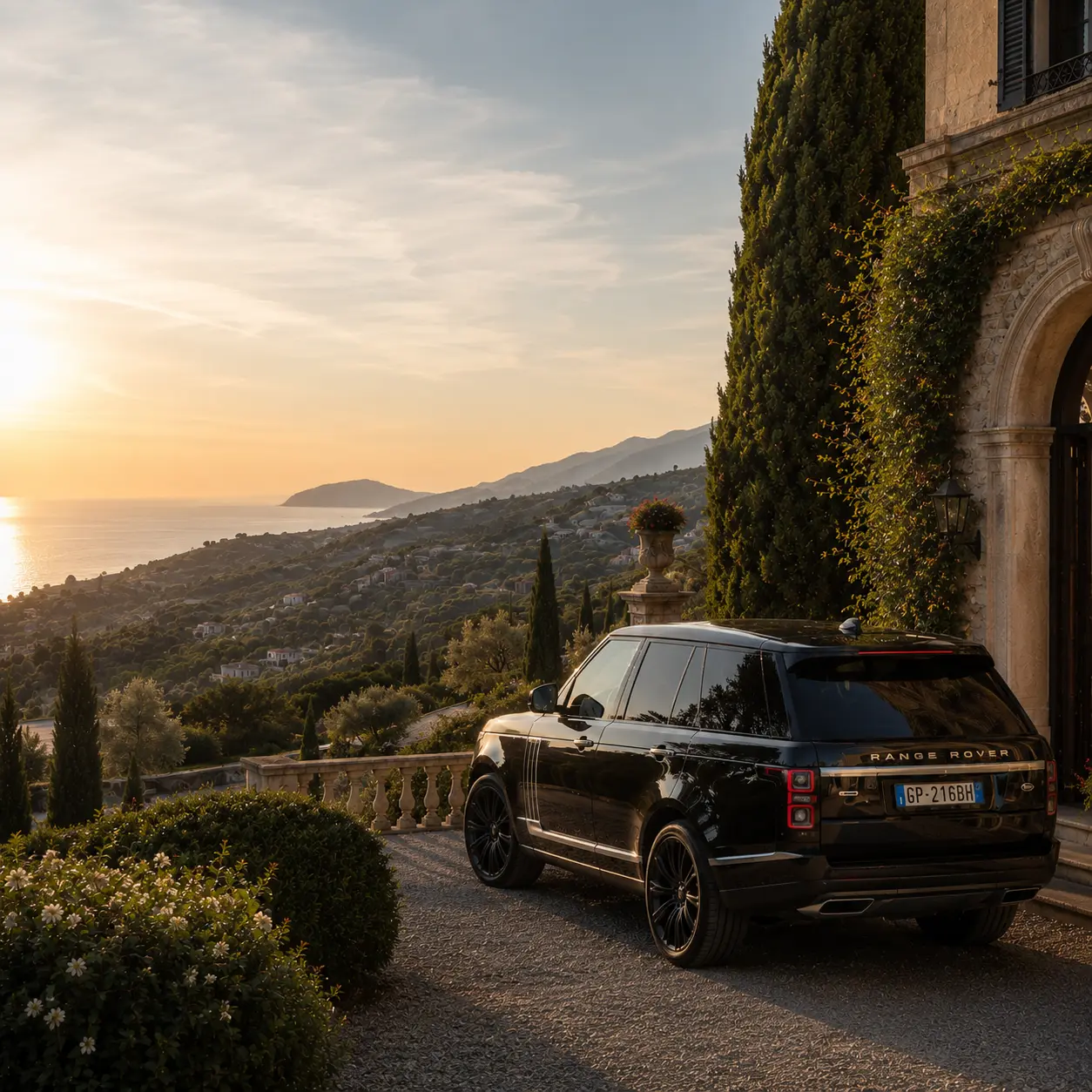
Some of Italy’s most remarkable luxury estates are found precisely where ordinary travel becomes less convenient.
They may stand at the end of a private road in the Tuscan countryside, above a secluded coastal bay, between Alpine valleys, beside a lake, or on an island with limited public connections. Their distance from major airports is not necessarily a disadvantage. In many cases, it is what protects their silence, views, privacy, and sense of retreat.
The real challenge is not choosing the estate. It is creating an arrival that feels worthy of it.
A long road transfer after an international flight, an unsuitable vehicle, an improvised helicopter connection, or poorly coordinated luggage can make an exceptional property seem unnecessarily difficult to reach. By contrast, a well-designed combination of private aviation, helicopter transfers, and luxury ground transportation can turn the journey into the first part of the experience.
The objective is not simply to travel faster. It is to create a continuous movement from the aircraft door to the estate terrace, with every handoff, vehicle, piece of luggage, and contingency already coordinated.
Why Italy’s most exclusive estates are often difficult to reach
Many of Italy’s finest private residences were not built around modern transportation infrastructure. Historic villas, agricultural estates, coastal homes, mountain chalets, and restored castles were positioned according to landscape, climate, farming, defense, and privacy rather than airport access.
This creates a distinctive geography of luxury. The most desirable property may not be located near Rome, Milan, Florence, Venice, or Naples. It may be hidden beyond a medieval village, surrounded by vineyards, separated from the main road by several miles of private land, or positioned on a coastline where a short distance on the map becomes a long journey by car.
The complexity usually comes from combining different environments:
- An international or intercontinental flight into Italy.
- A connection to a smaller or more strategically located airport.
- A helicopter or road transfer across mountains, lakes, islands, or congested coastal areas.
- A final approach along narrow, rural, steep, or private roads.
- The coordinated movement of passengers, luggage, staff, and vehicles.
Each segment may be simple on its own. Problems arise when the services are booked separately and no one is responsible for the complete journey.
The correct question is not “How far is the villa from the airport?”
Distance alone rarely explains how difficult an estate will be to reach.
A villa may be only 60 miles from an airport but require several hours of driving because of mountain roads, summer congestion, ferries, restricted historic centers, or the geography of a lake. Another property may appear farther away but be easily accessible through a regional airport, private aviation terminal, or authorized helicopter landing location.
The better question is:
Which combination of air and ground transportation creates the most reliable, comfortable, and private door-to-door journey?
This requires working backward from the desired arrival time at the estate and evaluating:
- The guests’ point of departure.
- The most appropriate Italian airport rather than only the nearest one.
- Aircraft and helicopter capacity.
- Road conditions and seasonal traffic.
- Passenger preferences and mobility needs.
- Luggage quantity and special equipment.
- Weather alternatives.
- The estate’s access road and arrival area.
This approach is especially important when several destinations must be connected in a limited period. The same principle is used in a carefully designed 48-hour itinerary through Milan, Florence, and Rome: the quality of the journey depends less on theoretical speed than on the continuity between each movement.
A door-to-door plan for remote luxury estates
A successful arrival should be designed from the original departure point to the entrance of the property, not as a series of unrelated reservations.
A typical sequence might include:
- A private jet reaching the most suitable airport for the region.
- A helicopter covering the most difficult or time-consuming overland section.
- A luxury SUV waiting at the landing location.
- A short and comfortable final drive to the estate.
- Luggage and staff arriving through a separate operational route when necessary.
Not every journey requires all three transportation modes. In some cases, a private jet followed by a chauffeured vehicle will be the most elegant solution. In others, a scheduled international flight followed by a helicopter may be more practical. For a countryside property, a well-equipped SUV may be more useful than any aerial transfer.
The correct solution is the one that removes friction without introducing unnecessary complexity.
Stage one: using private aviation to reach the right region
Commercial aviation is organized around major cities and fixed schedules. Remote luxury estates are not.
A scheduled flight may bring travelers into a well-connected international airport while leaving them several hours from the final property. Private aviation can alter that journey by making smaller or more strategically located airports available, subject to aircraft suitability, airport operations, and the requirements of the itinerary.
The principal benefit of a private jet service in Italy is therefore not limited to cabin comfort. It is the ability to shape the flight around the destination and the traveler’s schedule rather than forcing the itinerary to follow a commercial timetable.
When a private jet provides the greatest value
Private aviation becomes particularly useful when:
- The nearest practical airport has limited commercial connections.
- The guests are arriving as a family, delegation, or private group.
- Departure times must remain flexible.
- The itinerary includes several Italian regions.
- Privacy is important from the moment of arrival.
- The travelers have specialist luggage or equipment.
- A delayed or missed connection would compromise the stay.
- The trip is short and every usable hour matters.
Private aviation can also support a multi-estate journey. Guests may begin at a Tuscan residence, continue to a coastal villa, and conclude at an Alpine chalet without repeatedly returning to the country’s largest airports.
The nearest airport may not create the shortest journey
Choosing an airport only because it appears closest on a map can be a mistake.
A smaller airport may have limited operating hours, aircraft restrictions, fewer handling services, or weaker ground connections. A slightly more distant airport may provide better private aviation facilities, more reliable onward transportation, and more flexibility if the itinerary changes.
The airport decision should therefore be based on the entire route:
- Flight time and aircraft availability.
- Airport operating conditions.
- Distance from the helicopter or vehicle departure point.
- Ground traffic at the expected arrival time.
- Availability of a credible alternative.
- Passenger and luggage handling.
The goal is not to land as close as possible. It is to reach the estate through the smoothest complete sequence.
Stage two: when a helicopter solves the real geographical problem
Italy’s landscape often makes direct distance misleading. Mountains, lakes, peninsulas, islands, winding coastlines, and historic roads can turn a relatively short journey into a long overland transfer.
In these situations, a private helicopter charter in Italy can connect an airport with an authorized landing location near the property, link two estates in different regions, or bypass a road corridor affected by congestion or difficult terrain.
The helicopter should not be treated merely as a spectacular upgrade. Used correctly, it is a practical tool for protecting time, limiting fatigue, and maintaining the rhythm of the journey.
When a helicopter transfer makes sense
A helicopter can be particularly effective when:
- The final drive would involve several hours of coastal or mountain roads.
- The estate is located near an island, lake, remote valley, or peninsula.
- The guests are staying for only a few days.
- Seasonal congestion makes road timing unpredictable.
- The itinerary connects two properties in different regions.
- The traveler needs to reach a fixed event or appointment.
- The aerial journey contributes meaningfully to the experience.
A helicopter may also be incorporated into a broader itinerary in which transportation itself becomes part of the trip. This is similar to the logic behind combining sea and road travel in an Italian Riviera and Tuscany luxury itinerary: each mode of transportation is selected according to the landscape it serves best.
Can a helicopter land directly at a private villa?
Not automatically.
A lawn, field, or open area may appear suitable, but its appearance does not determine whether a helicopter operation can be conducted there. The operator must assess the available space, surface, obstacles, approach paths, local conditions, passenger load, aircraft type, and applicable permissions.
Some estates already have an established landing area. Others may be served through a nearby authorized site, private airfield, marina, hotel, or other suitable location.
The landing arrangement should be verified before the final itinerary is confirmed. A helicopter should never be added on the assumption that any large garden can function as a landing site.
When a helicopter is not the best answer
The fastest theoretical route is not always the most reliable or comfortable one.
A helicopter may be unsuitable when:
- Weather conditions are uncertain.
- The guests are uncomfortable flying in a helicopter.
- Luggage volume is incompatible with the selected aircraft.
- The available landing location remains far from the estate.
- The road journey is already short and predictable.
- The helicopter would add more transfers than it eliminates.
In these cases, a well-appointed vehicle with an experienced driver may create a better overall experience.
Stage three: completing the final mile by luxury vehicle
Even when private aviation and a helicopter remove most of the distance, the final approach to a remote estate is generally completed by road.
This final segment is often underestimated. Rural lanes may be narrow, mountain roads may be steep, coastal entrances may be difficult to identify, and private driveways may include gravel, uneven surfaces, or restricted turning space.
A carefully selected luxury car rental in Italy allows the vehicle to be chosen according to the property, passengers, and complete stay rather than appearance alone.
Why a luxury SUV is often the right arrival vehicle
A luxury SUV can provide:
- Greater luggage capacity.
- Comfortable entry and exit after a long flight.
- Better suitability for rural or uneven roads.
- Space for children, assistants, or security personnel.
- Improved flexibility in changing weather.
- A more discreet and practical profile than a sports car.
The vehicle can be positioned at the airport, heliport, marina, or estate before the guests arrive. It may be chauffeur-driven for the arrival and remain available for self-drive use during the stay.
The arrival vehicle and the experience vehicle can be different
A sports car may be ideal for a scenic drive but entirely unsuitable for carrying passengers and luggage along a gravel road.
In many itineraries, the best solution is to use:
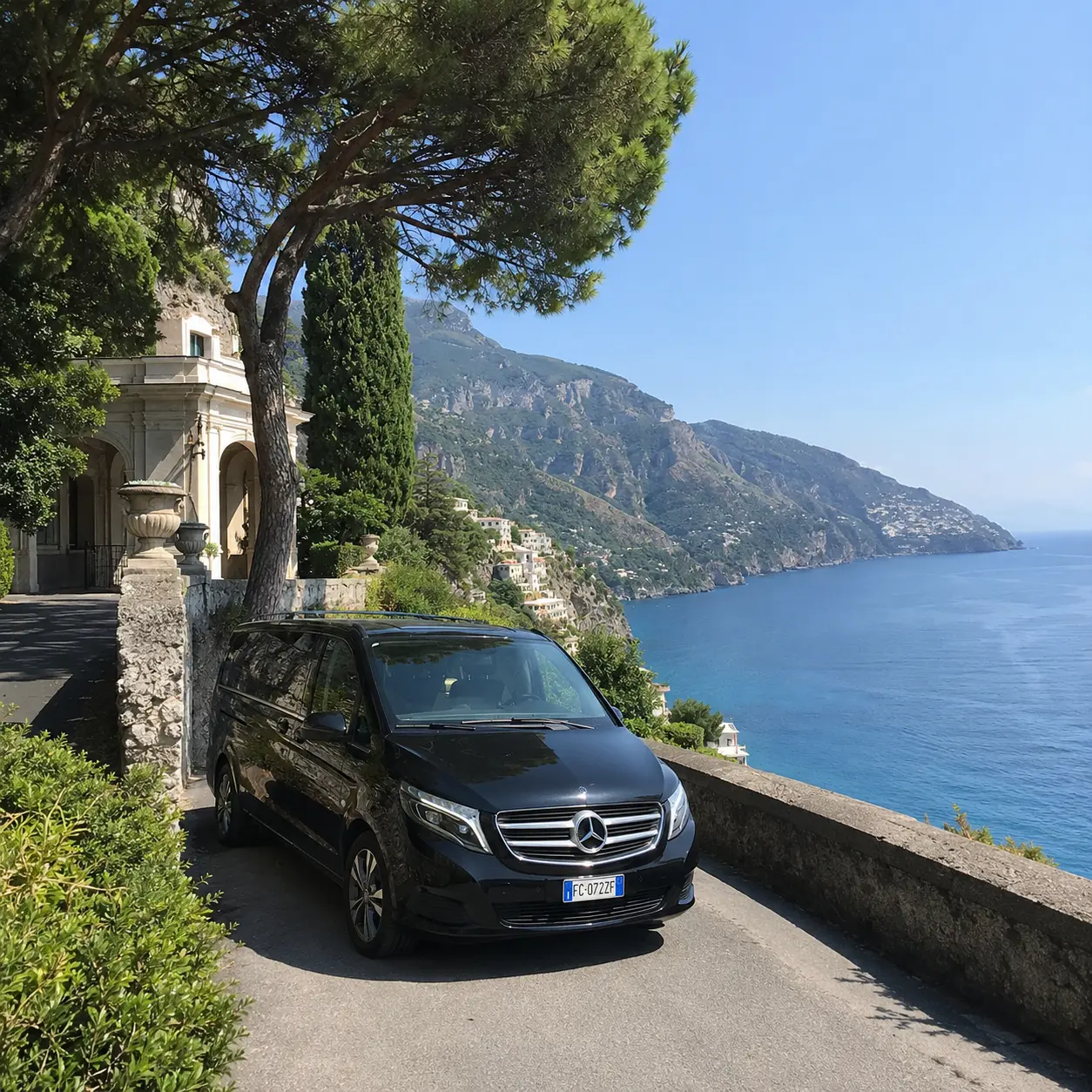
- A chauffeured SUV or luxury van for the arrival.
- A performance, vintage, or grand touring car for selected driving experiences.
- A separate vehicle for staff, luggage, or security.
This prevents the transportation plan from being compromised by the desire to use one vehicle for every purpose.
Private jet, helicopter, or luxury car: a decision framework
| Transportation mode | Best suited to | Main advantage | Primary consideration |
|---|---|---|---|
| Private jet | International arrivals, regional connections, and multi-destination trips | Schedule control and access to strategically located airports | Aircraft suitability, airport operations, luggage, and onward connections |
| Helicopter | Mountains, lakes, islands, coastlines, and time-sensitive transfers | Bypassing difficult terrain and protecting time | Weather, landing arrangements, capacity, and operational feasibility |
| Luxury SUV or chauffeured vehicle | Final-mile access, luggage movement, and transportation during the stay | True door-to-door flexibility | Road type, luggage, passenger count, and estate access |
For many remote estates, the answer is not one option but a carefully coordinated combination.
How the ideal arrival changes by destination
There is no universal transportation plan for Italy’s remote properties. Each landscape creates a different access problem.
Tuscany and Umbria
Countryside estates frequently combine narrow local roads, long private driveways, gravel surfaces, protected landscapes, and significant distances between towns.
A private aircraft may reduce the journey to the most appropriate regional airport, but the final arrival will usually depend on a comfortable road transfer. A luxury SUV is generally more practical for luggage and estate access than a low performance car.
Helicopter transfers may be appropriate for short stays, multi-region itineraries, or properties with suitable nearby landing arrangements. They offer less value when the guest still faces a substantial drive after landing.
Travelers combining Tuscany with the Ligurian coast should also consider the overall sequence rather than treating the two regions as separate trips. A sea-to-road itinerary can provide a more natural transition between coastal exploration and countryside living.
Lake Como and other lake destinations
A lakefront villa may appear close to Milan or another major city while remaining difficult to reach because of traffic, shoreline geography, tunnels, mountain roads, or limited property access.
Depending on the villa, the most elegant sequence may combine:
- Private aviation into the most appropriate airport.
- A helicopter transfer toward the lake.
- A chauffeured vehicle for the final road segment.
- A private boat when the property is more naturally approached from the water.
The correct plan depends on the location of the entrance, dock, landing point, and accommodation—not only the destination name.
The Dolomites and Alpine estates
Mountain properties require careful attention to weather, daylight, altitude, snow conditions, seasonal road closures, and vehicle suitability.
A helicopter can substantially reduce travel time when conditions and infrastructure permit. A capable chauffeured vehicle should still be positioned for the final connection and for transportation during the stay.
Winter itineraries should include realistic buffers and a complete ground alternative. An arrival designed around perfect weather alone is not a robust luxury plan.
Remote coastal villas
Italy’s dramatic coastal landscapes are rarely served by simple, high-capacity roads. The final journey may involve switchbacks, historic towns, summer congestion, restricted entrances, or marinas located far from the property.
A helicopter may remove the longest road section, while an SUV completes the final approach. In other cases, reaching the area by yacht and tender may be more natural than arriving from inland.
The air, sea, and road components must be synchronized. A beautiful helicopter flight or yacht transfer loses much of its value if the guest arrives at the handoff point before the vehicle, luggage, or estate staff.
Island properties
Island estates introduce additional layers because aircraft, helicopters, ferries, yachts, marinas, tenders, and local vehicles may all be involved.
For travelers interested in destinations beyond the most conventional routes, a private vessel can also provide access to hidden Italian islands and remote coastal areas best explored by yacht.
The passenger route and luggage route may be different. Guests may arrive by helicopter or yacht while bags, staff, provisions, and equipment travel separately. Vehicles should already be positioned on the island rather than arriving after the principal party.
Luggage needs its own transportation strategy
Passengers and luggage do not always need to follow the same route.
This becomes especially important when a helicopter is involved. Families staying for several weeks, guests carrying formal clothing, sports equipment, children’s items, professional equipment, or multiple suitcases may have more luggage than the preferred aircraft can accommodate efficiently.
A better solution may be to:
- Identify the bags that must remain with the guests.
- Send the remaining luggage directly to the estate by road.
- Position essential clothing and personal items in the property before arrival.
- Assign one person to supervise collection, identification, and delivery.
- Prepare a contingency in case the guest’s route changes.
This allows passengers to use the fastest or most comfortable transportation mode without forcing every item through the same sequence.
Planning for families, assistants, staff, and larger groups
The transportation plan becomes more complex when the principal guests travel with children, assistants, caregivers, chefs, security professionals, or household staff.
Moving everyone through the same route at the same time may be inefficient. A more effective strategy may separate the guest arrival from the operational arrival.
For example:
- Staff and luggage reach the estate earlier by road.
- The principal guests arrive by private jet and helicopter.
- Child seats, refreshments, and personal items are prepared in advance.
- A second vehicle handles assistants or security personnel.
- The estate team receives one continuously updated arrival time.
For larger parties, the capacities of the aircraft, helicopter, and vehicles must be compatible. A plan should never depend on transporting ten passengers in an aircraft configured for a smaller group without an agreed sequence.
Privacy should continue beyond the airport
A remote estate may provide complete seclusion once the gates close, but the journey can still expose guests at terminals, vehicle collection points, public docks, hotel entrances, or roadside meeting locations.
For celebrities, executives, public figures, and UHNW families, privacy must be protected during each transition.
This can involve:
- Using private aviation terminals where appropriate.
- Limiting the number of people who receive the complete itinerary.
- Coordinating communication through one representative.
- Positioning vehicles before the guests arrive.
- Avoiding public name signs and unnecessary waiting.
- Selecting discreet vehicles rather than automatically choosing the most conspicuous model.
- Briefing drivers, estate staff, and other providers on confidentiality.
For high-profile clients, these measures should form part of a broader privacy-first travel strategy in Italy. The private villa is only one controlled environment. The arrival route must connect it to the previous controlled environment without creating avoidable exposure points.
Weather contingencies should be built before departure
Weather can affect both private aviation and helicopter operations, particularly in mountain, coastal, lake, and island destinations.
A high-level arrival plan should therefore include a complete alternative route rather than an undefined promise to arrange a car if conditions change.
The contingency should establish:
- The alternative airport or landing location.
- The ground vehicle and driver.
- The estimated road travel time.
- The revised luggage route.
- The communication process for guests and staff.
- Any changes required to dining, check-in, or property services.
The alternative vehicle should not begin moving only after a helicopter is canceled. It should already be positioned or immediately available under a predetermined plan.
The guest should receive one clear update and one revised arrival time. The operational complexity should remain invisible.
What a fully coordinated arrival can look like
Consider guests traveling from London to a secluded estate in the Italian countryside.
Instead of taking a commercial flight to a major airport and beginning a long road transfer, they depart on a private aircraft at a time aligned with the villa check-in and planned dinner.
The flight reaches the airport selected for the most efficient onward journey. Essential luggage remains with the guests, while larger bags are collected separately and transported directly to the estate.
A helicopter covers the most time-consuming section and reaches a previously assessed landing location. A luxury SUV is already waiting with refreshments, child seats, or any requested personal items.
The final drive is short and scenic. At the estate:
- The luggage has already been placed in the appropriate rooms.
- The staff knows the confirmed arrival time.
- Food and refreshments have been adjusted to the schedule.
- Additional vehicles are available for the stay.
- No guest needs to coordinate with separate operators.
No single vehicle defines the experience. The luxury comes from the continuity between them.
The most common mistakes when reaching a remote estate
Booking the property before evaluating the journey
An exceptional estate may still be the correct choice, but its access requirements should be understood before flights and arrival times are confirmed. The journey may influence the ideal length of stay, vehicle selection, luggage strategy, and suitability for specific guests.
Selecting an airport only because it appears closest
Airport suitability depends on operating conditions, aircraft requirements, ground services, traffic, and onward transportation—not only geographic distance.
Assuming a helicopter can land at the estate
The location must be assessed in advance. The availability of open land does not automatically make a direct landing feasible.
Using a helicopter without a road contingency
Aerial transportation can be valuable, but the itinerary should remain viable if weather or operational conditions change.
Choosing a vehicle for appearance rather than access
A supercar may be ideal for a curated driving day but inappropriate for carrying luggage along a steep or uneven estate road.
Ignoring luggage until the day of travel
Luggage quantity can affect the aircraft, helicopter, road vehicles, timing, and number of separate transfers required.
Booking every service through a different contact
When flights, helicopters, vehicles, luggage, and estate staff are coordinated independently, no one controls the transitions. One central team should oversee the complete journey.
A practical planning checklist
Before confirming transportation to a remote luxury estate in Italy, verify the following:
- The complete address and exact access point of the property.
- The condition and dimensions of the final road or driveway.
- The most suitable airport for the entire journey.
- Aircraft and passenger capacity.
- Helicopter landing feasibility or the nearest usable location.
- Expected luggage volume.
- The number and type of ground vehicles required.
- Child seats, mobility assistance, or security needs.
- Seasonal traffic and road restrictions.
- Weather alternatives.
- Communication between aviation, drivers, and estate staff.
- The person responsible for the complete sequence.
Frequently asked questions
What is the best way to reach a remote luxury villa in Italy?
The best solution depends on the property’s location, the travelers’ departure point, passenger count, luggage, schedule, and available infrastructure. Particularly remote estates may require a combination of private aviation, helicopter transfers, and a luxury SUV.Can a private jet land near a countryside estate?
Private aviation may make smaller or more strategically located airports available, depending on the aircraft, route, airport conditions, and operational requirements. The final segment generally continues by helicopter or road.Can a helicopter land in the garden of an Italian villa?
Only when the proposed location is suitable and the flight can be operated under the necessary safety and operational conditions. The site must be assessed in advance. When a direct landing is not possible, a nearby authorized location can be used.How much luggage can be carried on a helicopter?
Capacity depends on the helicopter, route, passenger count, conditions, and operator requirements. When guests have several bags, part of the luggage can be transported separately to the estate by road.Is a helicopter always faster than a car?
No. The complete journey must include transportation to and from the landing locations, boarding, luggage handling, weather, and the estate’s actual position. A helicopter is most useful when it eliminates a genuinely difficult or time-consuming road segment.What vehicle is best for reaching a remote estate?
A luxury SUV is often the most versatile option because it provides passenger comfort, luggage capacity, and better suitability for rural, coastal, or mountain roads. Other vehicles can be delivered separately for driving experiences or formal events.What happens if weather prevents the helicopter transfer?
A complete ground alternative should already be prepared. The vehicle, driver, route, luggage process, and revised arrival time should be defined before the trip begins.How far in advance should the arrival be organized?
Complex itineraries should be planned as early as possible, especially during peak seasons or when they involve private aircraft, helicopters, remote islands, large groups, specialist luggage, or properties with limited access.Can luggage and passengers travel separately?
Yes. Separating passenger and luggage logistics can make the journey faster and more comfortable, particularly when helicopter capacity is limited or the guests are staying for an extended period.Who should coordinate all the transportation services?
One central concierge team should manage the flight, helicopter, vehicles, luggage, drivers, and communication with the estate. This prevents gaps between separate providers and gives the guest one reliable point of contact.
Turning a remote location into a seamless arrival
A remote luxury estate should feel private, not inaccessible.
The difference lies in treating the journey as one continuous experience. The private jet reaches the correct region. The helicopter protects time where geography makes road travel inefficient. The luxury vehicle completes the final mile with the comfort and practicality the property requires. Luggage, staff, privacy, and weather alternatives follow the same plan.
Italia Concierge coordinates these transitions as part of the stay rather than as separate transportation bookings. Working with a bespoke travel concierge in Italy makes it possible to design the arrival around the property, the guests, and the way they prefer to travel—so that the sense of luxury begins before the estate comes into view and continues uninterrupted from the tarmac to the terrace.